The rules of online visibility are being rewritten. Here is what every business needs to know right now.
Something big has changed in the world of the internet. And most businesses have not noticed it yet.
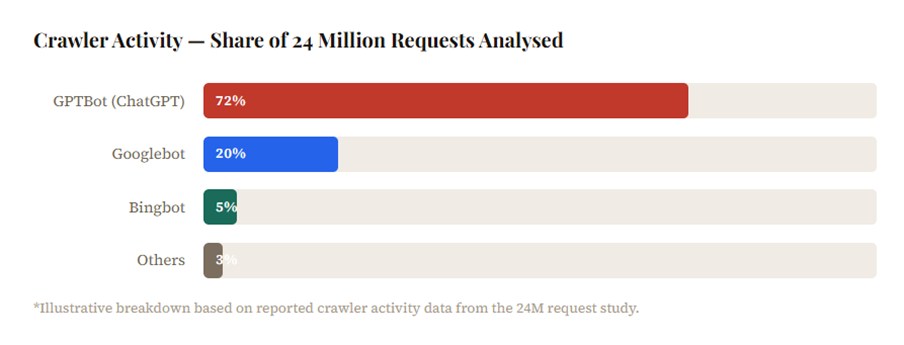
For more than two decades, Google has been the undisputed king of web crawling. Googlebot visited your website, read your content, and decided where you ranked. That was the game. That was SEO. But a new study analysing over 24 million web requestshas revealed something that is turning heads across the digital marketing world:ChatGPT’s crawler is now visiting websites 3.6 times more often than Googlebot.
Read that again. ChatGPT — the AI chatbot from OpenAI — is crawling the web more aggressively than Google’s own bot.
As a Digital Marketing Company in Kolkata that keeps a close eye on global digital trends, we believe this is one of the most important shifts to understand in 2025 and beyond.
“Optimising only for Google in 2025 is like advertising only on TV in 2010. The audience has moved. Your strategy must move too.”
First, What Is Web Crawling — And Why Does It Matter?
When you publish a blog post or a product page on your website, how does anyone find it? Through search engines and AI tools — but before they can show it to users, they have toread it. That reading is called crawling.
A web crawler (also called a bot or spider) is basically an automated program that visits web pages, reads the content, and sends it back to be processed and stored. Google has Googlebot. Bing has Bingbot. And OpenAI has GPTBot — the crawler behind ChatGPT.
The more a bot crawls your site, the more likely it is that your content will appear in that platform’s results. So when we say ChatGPT’s bot is crawling 3.6x more than Googlebot, it means ChatGPT is far more hungry for fresh content — and your website is being read and assessed for AI-generated answers at a pace that was unimaginable just two years ago.
What Did the 24 Million Requests Study Actually Find?
The data came from an analysis of web server logs across a large set of websites — tracking who was visiting, how often, and from where. Here are the key findings that stood out:
- GPTBot topped the charts – OpenAI’s crawler visited websites 3.6 times more frequently than Googlebot during the study period. This is not a marginal difference — it is a massive gap.
- AI crawlers are fast and relentless – Unlike traditional bots that follow a schedule, AI crawlers often return to pages multiple times in short windows. They are not just indexing — they are actively feeding a language model that needs constant updates.
- Content depth mattered more than keyword density – AI crawlers spent significantly more time on pages with detailed, well-structured, and informative content. Thin pages were often skipped or visited briefly.
- Structured data was favoured – Pages with clean HTML, proper headings, FAQs, and schema markup received more frequent visits from AI bots.
- Speed still counts – Sites with slow loading times were crawled less efficiently, even by AI bots. Fast websites got more thorough visits.
Also read this Blog – ChatGPT Vs. Traditional Copywriting: What Works Best?
Why Is ChatGPT Crawling So Much?
The answer is simple when you think about how ChatGPT works. It is a generative AI tool — meaning it does not just point you to a link. It actually writes an answer for you. To write accurate, current answers, it needs to continuously read and learn from fresh web content.
Think of it this way: Google shows you a list of doors and lets you choose which one to open. ChatGPT opens the door itself, reads the room, and then tells you a summary of everything inside. To do that well, it needs to be inside those rooms very, very often.
Did You Know
“When a user asks ChatGPT a question like “best digital marketing services in Kolkata,” ChatGPT does not search a keyword index. It synthesises an answer based on what its crawler has already read and learned from websites. If your website was not crawled or did not have strong, clear content — you simply will not be mentioned.”
What Does This Mean for Your Business and Website?
This is the part that every business owner and marketing manager needs to sit with for a moment. The shift from traditional SEO to what people now callAI-Optimised Content(or GEO — Generative Engine Optimisation) is not coming in the future. It is already here.
Here is what is changing on the ground:
1. Ranking on Google is No Longer the Only Goal
Until recently, the entire job of a digital marketing strategy was to rank on Google. Page 1. Position 1. Done. But now, millions of people are getting their answers directly from ChatGPT, Gemini, Claude, and Perplexity — without ever visiting Google at all. If your business is not mentioned in those AI-generated answers, you are invisible to a growing chunk of your audience.
2. Content Quality Is More Important Than Ever
AI bots are not just counting keywords. They are actually reading and understanding what you have written. A page stuffed with keywords but thin on real information will score poorly. A page that genuinely answers questions, provides depth, and is structured clearly will be favoured — both by AI crawlers and by the users they serve.
3. Your Website’s Technical Health Is Critical
Speed, mobile-friendliness, clean code, proper use of headings and structured data — these are no longer optional extras. They directly affect how well AI bots can read and understand your site. A technically poor website will simply not be crawled or cited as effectively.
Kolkata Business Tip: If you are running a local business in Kolkata — whether it is a retail store, a clinic, a law firm, or an e-commerce brand — your potential customers are increasingly asking AI tools for recommendations. Showing up in those AI responses requires a different kind of content strategy. Partnering with a good Digital Marketing Company in Kolkata that understands both traditional SEO and AI-era ptimization is now a genuine competitive advantage.
Traditional SEO vs. AI-Era Optimisation — What Has Changed?
|
The Shift From Old SEO to AI-Era Strategy |
|
|
Traditional SEO (Pre-2024) |
AI-Era Optimisation (Now) |
| Rank on Google’s Page 1 as the primary goal | Being cited in AI answers is equally important |
| Focus on keyword frequency and backlinks | Focus on content depth, clarity, and authority |
| Content written to satisfy Google’s algorithm | Content written to inform real human questions |
| Schema markup was optional and niche | Structured data is essential for AI comprehension |
| Thin FAQ pages performed well | Rich, detailed pages win across all platforms |
| One major bot to satisfy: Googlebot | Multiple AI bots to optimise for simultaneously |
| Traffic mainly from search engine clicks | Traffic from AI referrals is growing rapidly |
5 Practical Steps You Should Take Right Now
Whether you manage your own website or work with a digital marketing team, here are five actionable things to focus on in the wake of these findings:
- Audit your content for depth – Go through your key pages and ask: does this actually answer a user’s question in full? If a page is just 200 words with a few keywords, it is time for a rewrite. AI crawlers reward comprehensive, well-organised information.
- Add FAQ sections to important pages – AI tools love question-and-answer formats. Adding a well-written FAQ section to your service pages, product pages, and blog posts dramatically improves your chances of being cited in AI-generated responses.
- Improve your page speed – Use free tools like Google PageSpeed Insights. A website that loads in under 2 seconds is not just good for user experience — it is now a factor in how thoroughly AI crawlers can visit your site.
- Do not block AI crawlers – Some website owners have added GPTBot to their robots.txt disallow list out of concern about data usage. Unless you have a specific legal or business reason, this actively hurts your visibility in AI-generated answers. Let them crawl.
- Build topical authority – Do not just write one blog post on a topic. Build clusters of related content that demonstrate your brand is a genuine expert. AI systems reward websites that show deep knowledge in a specific area rather than scattered, surface-level coverage.
What This Means for Businesses in Kolkata
Kolkata’s business landscape is evolving fast. From startups in Salt Lake’s tech hub to traditional businesses on Park Street — every company now has a digital footprint that needs to be managed strategically. The rise of AI-driven search is not just a global phenomenon. It is playing out right here, in the way Kolkata’s consumers and B2B buyers find services, compare options, and make decisions.
Also read this Blog : Content Alone Isn’t Enough: Why SEO Now Requires Distribution
When someone in Kolkata types “best accounting firm near me” into ChatGPT, or asks Perplexity “which digital agency in Kolkata should I work with” — the AI does not pull up a Google rankings list. It synthesises an answer based on what it has read from across the web. That means the business with the most credible, clear, and crawlable online presence wins — regardless of whether it has spent lakhs on traditional ads.
For a growing Digital Marketing Company in Kolkata, staying ahead of this curve means constantly updating both content strategy and technical foundations. It means writing for humans first, structuring for machines second — and never treating SEO as a one-time task.
“The businesses that will dominate AI-era discovery are not the ones with the biggest budgets. They are the ones with the most genuinely useful, well-structured, and consistently updated digital presence.”
The Bottom Line
The data is clear. ChatGPT’s crawler is not a minor player — it is now the most active bot on the web. That means your website is being read, evaluated, and potentially cited (or ignored) by AI systems millions of times a day. Your strategy needs to reflect that reality.
This does not mean you should abandon Google SEO. It means you shouldexpandyour thinking to include the growing world of AI-driven discovery. A good website — fast, deep, well-structured, and genuinely helpful — now works harder for you than ever before, feeding both traditional search rankings and AI-generated recommendations at the same time.
The businesses that act on this insight early will have a significant head start. The ones that wait will find themselves optimised for a game that has already moved on.
If you are unsure where to start, that is exactly where a knowledgeable Digital Marketing Company in Kolkata can help — building a strategy that is ready not just for today’s SEO, but for the AI-powered internet that is already here.