You type a question into Google, hit enter, and before a single blue link appears, a wall of AI-generated text fills the screen. No sources you recognise. No way to tell where the answer came from. Just a confident summary that may or may not be right. If that feeling has started to irritate you, you are not alone. A quiet but growing number of people are doing something about it. They are switching to search tools that put links first and keep the AI out of the way.
This shift is small for now, but it carries a clear message for any business that depends on being found online. The way people search is splitting in two, and the brands that understand both paths will keep winning visibility while others watch their traffic slip away.
What “AI-Free Search” Actually Means
AI-free search is not about rejecting technology. It describes a preference for the older, familiar way of finding information: you ask, you get a list of sources, and you choose where to click.
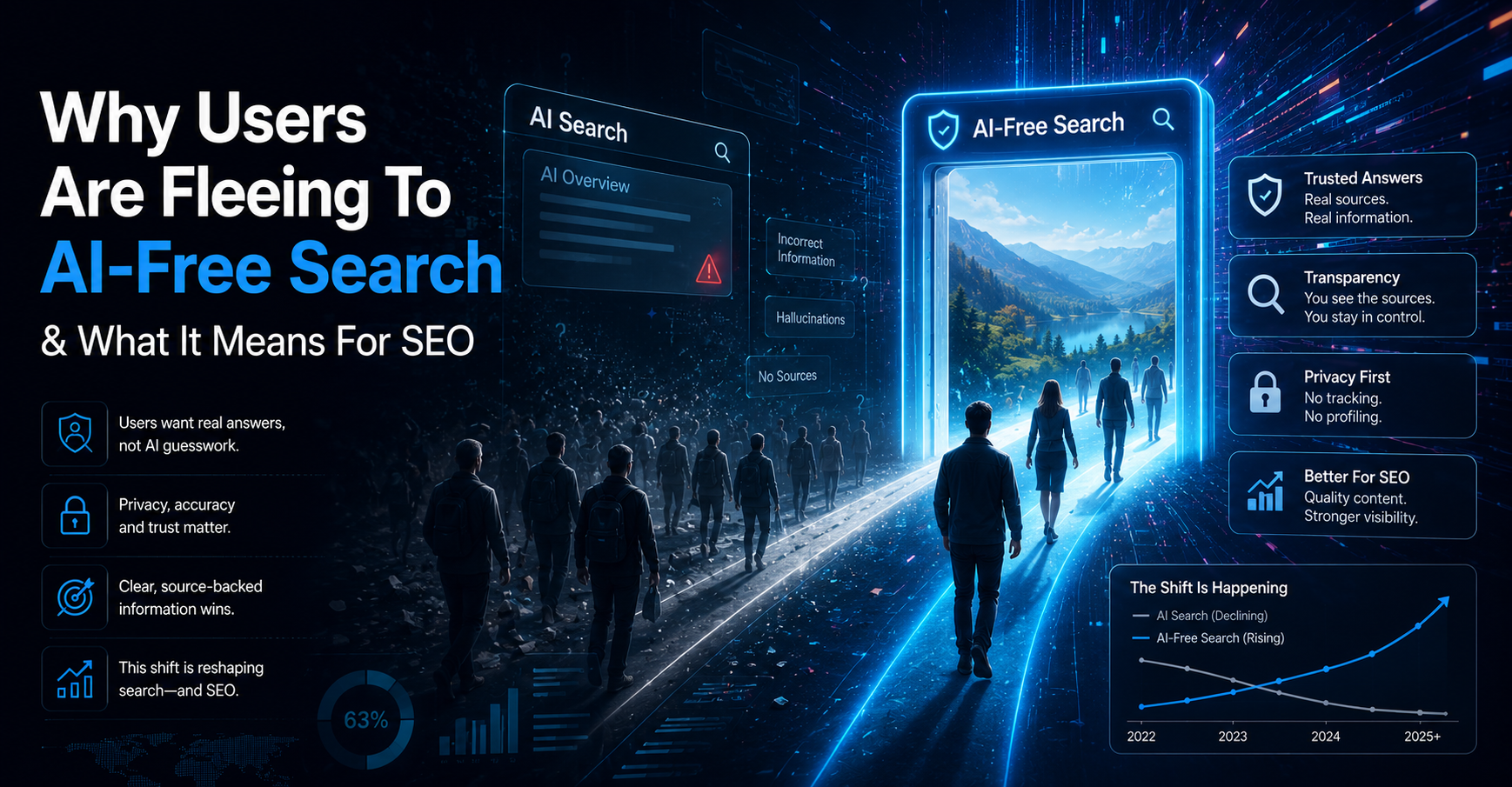
In 2026, almost every major search engine ships with an AI layer switched on by default. After Google’s I/O 2026 announcements, which the company itself called the biggest change to its search box in twenty-five years, frustration boiled over. DuckDuckGo reported a measurable jump in US app installs and a rise in traffic to its AI-free search page, according to coverage in the technology press that month. Some of that movement is protest, and protest can fade. But the fact that people went to the trouble of switching at all matters, because changing your search habit is genuinely inconvenient.
The complaint is rarely that AI exists. It is that AI has become the default front door, and many users want the choice to walk through a different one.
Why People Are Walking Away From AI-Heavy Search
The reasons sit at the intersection of psychology and plain practicality. Research published in Nature Human Behaviour by De Freitas and colleagues points to a few barriers that explain the pushback, and they map neatly onto search.
Also, read this blog: How GA4 Tracks AI Assistant Traffic After FAQ Search Results Vanished
They Want Their Sense of Control Back
When a search engine forces a chat interface in front of you, it can feel like a decision is being made on your behalf. For people who treat search as a simple tool rather than a toy to experiment with, that loss of control breeds anxiety. They head to alternatives that respect how they prefer to work, even if those alternatives are less polished.
The Black Box Problem
A synthesised answer that does not clearly show its working is, to many people, a black box. You cannot see how the conclusion was reached or judge whether the underlying sources were any good. Trust collapses fast when accuracy is uncertain and the reasoning stays hidden. Anyone who has been burned by a confidently wrong AI summary knows the instinct to go back to reading the source material directly.
Verification Fatigue
Here is the irony. AI promised to save time, yet careful users now spend extra effort double-checking what the AI told them. A 2026 survey of search behaviour found that more than half of respondents start a search by opening an AI app, but use of Google has not actually declined. People are layering tools, not replacing them, and for a meaningful slice of users the simplest path is to skip the AI step entirely.
What This Means For Your SEO Strategy
It would be a mistake to read this trend as a sign that AI search is failing. The bigger picture is the opposite. Studies through early 2026 show that roughly 37% of consumers now begin a search with an AI tool, and zero-click searches account for around 60% of all queries. Publishers have felt the damage, with some informational sites reporting organic traffic declines of 20% to 40%, and a handful losing far more.
So you are now optimising for two audiences at once: the people leaning into AI answers, and the people deliberately stepping away from them. Sensible strategy serves both.
Classic Ranking Signals Have Not Gone Anywhere
The users fleeing to AI-free search still rely on traditional ranking factors. Page quality, clear structure, fast load times, genuine authority, and clean technical foundations all still decide who they click. If anything, this group is more discerning, because they are reading sources rather than skimming a summary. Solid, trustworthy content earns their attention.
Build Content That Both Worlds Can Use
Write so a human reader and an AI summariser both find value. That means answering the core question early and plainly, then going deeper for readers who want the full picture. Use clear headings phrased the way people actually ask things. Cite real evidence and name your sources. Content built this way gets quoted inside AI Overviews while still rewarding the visitor who clicks through and stays.
Local Intent Is Your Safe Harbour
There is good news for businesses with a physical footprint or a local market. AI coverage for local and “near me” queries remains low, well under 15% by most 2026 estimates, because search engines still send these searches to map results and local listings. If your customers look for services in a specific city, local SEO is one of the most resilient investments you can make right now.
How the Right SEO Partner Helps You Stay Visible
Navigating a search landscape that is fracturing in real time is not a job for guesswork. It calls for someone watching the data, testing what works across both AI and traditional results, and adjusting before your rankings react. This is where an experienced SEO Company in Kolkata earns its keep.
At Lee & Nee Softwares (Exports) Ltd, we have spent years helping businesses adapt as search keeps reinventing itself. Our approach does not chase a single trend. We build content and technical foundations strong enough to perform whether your audience prefers AI answers or the link-first experience they grew up with. We keep a close eye on local visibility, structure your pages so they get cited and clicked, and ground every decision in measurable results rather than hype. For companies that want a dependable SEO Company in Kolkata to steer them through this transition, the goal is simple: keep you found, whoever your customers ask.
The split in search behaviour is not a threat if you prepare for it. It is an opening for brands ready to show up cleanly on every path a customer might take.
Frequently Asked Questions
What is AI-free search?
AI-free search refers to using a search engine in its traditional mode, where you receive a list of links to sources rather than an AI-generated summary. Several engines now offer settings or dedicated pages that strip out the AI layer for users who prefer it.
Are people really leaving AI search engines?
Some are, though the numbers are modest so far. After Google’s 2026 search overhaul, engines such as DuckDuckGo reported rising installs and more traffic to their AI-free options. At the same time, AI search use keeps growing overall, which means the audience is dividing rather than moving in one direction.
Will AI search hurt my website traffic?
It can, particularly for informational content that AI summaries answer directly on the results page. Reported declines range from 20% to 40% for affected queries. Local and commercial searches have been far less impacted, which is why a balanced SEO strategy matters more than ever.
How do I optimise for both AI and traditional search?
Answer the main question early and clearly so AI tools can quote you, then provide deeper, genuinely useful detail for readers who click through. Use natural, question-based headings, cite credible sources, and keep your technical SEO clean. A capable SEO Company in Kolkata like Lee & Nee Softwares can build and maintain this dual approach for you.
Is local SEO still worth investing in?
Yes, and arguably more than before. AI coverage of local and “near me” searches remains low because engines still favour map listings and local results for these queries, making local SEO one of the most stable returns available in 2026.