Online shopping has changed fast. Today, millions of buyers ask AI tools like ChatGPT, Google AI Overviews, and Gemini to recommend products before they ever click on a website. Instead of scrolling through ten blue links, shoppers ask specific questions like, “What are the best waterproof hiking boots under $150?”
When AI answers that question, you want your product to be the top pick. However, recent studies show that AI shopping tools make mistakes—and those mistakes can silently cost you sales. In fact, recent research on AI shopping agents found that they fail over 40% of the time when trying to match products to a shopper’s exact needs.
If you want AI tools to recommend your brand, you need to fix the data feeding them. Here is a simple breakdown of the most common AI shopping errors and how you can fix them today.
Table of Contents
Toggle3 Common AI Shopping Errors Hurting Your Sales
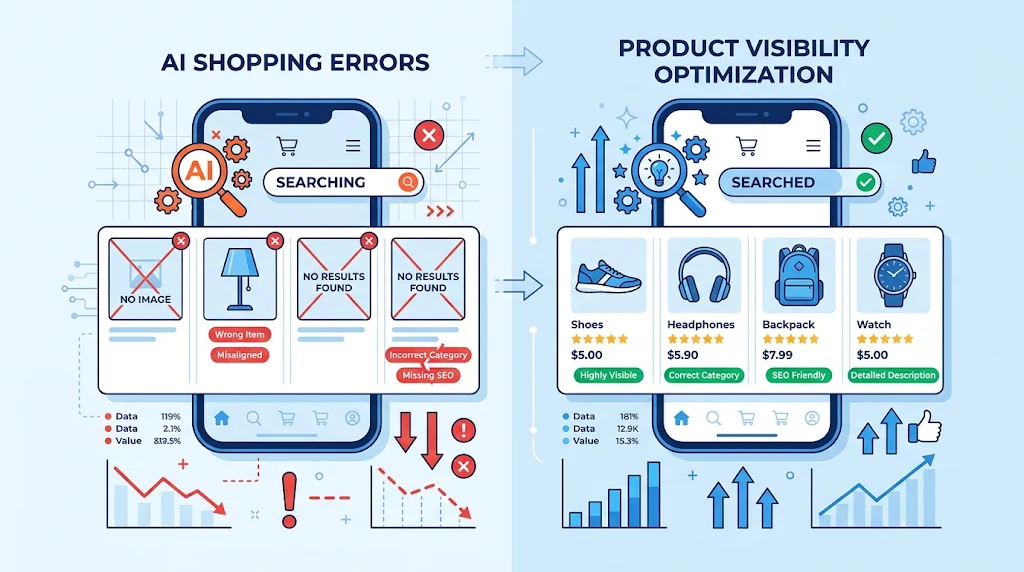
According to recent industry data, AI product recommendations usually go wrong in three major ways:
-
Your Products Are Invisible: A shopper asks for a product you sell—like a warm winter jacket—and your brand doesn’t even show up in the AI answer, or it gets buried below your competitors.
-
Wrong Prices, Stock, or Specs: AI pulls outdated details. It might tell a shopper your product costs $129 when it is actually on sale for $99, list an item as “in stock” when it is sold out, or get basic features like battery life wrong.
-
Competitors Steal the Buy Link: Even when AI recommends your product, it might send the shopper to a third-party marketplace or reseller instead of your own online store.
Why Do AI Tools Make These Mistakes?
AI tools do not guess on purpose; they get confused by messy data. When your website, your product feeds, and third-party listings show slightly different prices, product names, or stock levels, the AI has to pick one. Often, it picks the wrong one.
Slow websites, thin product descriptions, and outdated FAQs also make it hard for AI crawlers to understand what you sell and who your product is for.
Read More: Why Users Are Fleeing To AI-Free Search & What It Means For SEO
How to Fix AI Shopping Errors: 5 Easy Steps
You don’t need to rebuild your whole store to fix this. Focus on cleaning up the product information you already control:
-
Keep Your Product Feeds Synced in Real Time: Make sure the prices, discounts, and stock numbers on your product pages match your Google Merchant Center and shopping feeds. Consistency builds trust with AI systems.
-
Write Clear, Use-Case Product Descriptions: Don’t just list technical specs. Explain who the product is for and how it is used. For example, clearly state if a pair of shoes is meant for “daily city walking” or “muddy trail running” so AI matches the right item to the right shopper.
-
Update Your Customer Reviews and FAQs: AI tools often summarise customer reviews to tell shoppers what buyers think. Encourage recent buyers to leave fresh reviews, and add a short FAQ section on each product page to answer common questions about sizing, warranties, and shipping.
-
Speed Up Your Website and Mobile Experience: Slow pages and clunky mobile layouts hurt both traditional search rankings and your chances of appearing in AI answers. Compress large images and keep your product pages clean and easy to read.
-
Test Your Own Products in AI Tools: Open ChatGPT or Gemini in a logged-out browser and ask buying questions related to your best sellers. Check which brands appear, verify if your prices are right, and update any product pages where the AI gets your details wrong.
Read More: What Google AI Overview Means for SEO
Need Help Getting Found by Shoppers and AI?
Keeping up with changing search engines and AI shopping algorithms takes ongoing effort. From cleaning up technical website structure and schema markup to optimising product pages, having the right digital partner makes all the difference.
If you are looking for a trusted SEO Company in Kolkata, Lee & Nee Softwares (Exports) Ltd helps businesses stay visible across both traditional search engines and modern AI platforms. With customised SEO strategies, technical audits, and data-driven content optimisation, our team ensures your products show up accurately right when customers are ready to buy.